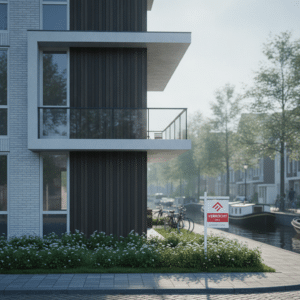
Buy-to-Let Mortgage in the Netherlands: Rules and Own Funds for Expats
If you are exploring a buy-to-let mortgage in the Netherlands as an expat, you need to know one thing first: a normal owner-occupied Dutch mortgage is usually not meant for renting out the property. Standard residential mortgages are for homes you live in yourself, while rental property usually needs a different structure, higher own funds, and a lender that explicitly accepts the plan.
For expats, this matters even more. Dutch lenders often assess internationals with extra care, especially when income, residency plans, or future housing plans are not fully standard. Expats can get a Dutch mortgage, but lenders will review income stability, contract type, and documentation closely. A buy-to-let case adds another layer, because the lender also wants to understand rental use, risk, and how much of the purchase you can fund yourself.
This guide explains the exact search intent behind the topic. Can you rent out a property on a standard mortgage? Usually not. Is a buy-to-let mortgage in the Netherlands for expats possible? Yes, often it is. Do you need your own money? In practice, yes, and usually quite a lot. On top of that, you also need to factor in transfer tax, notary fees, valuation costs, and a risk buffer. The goal is simple: help you understand whether your plan is realistic before you bid, spend money, or make assumptions that could become expensive later.
Buy-to-Let Mortgage in the Netherlands as an Expat: What Is Allowed?
A lot of confusion starts here. Many buyers assume they can first get a normal residential mortgage and then rent out the home later. In most cases, that is the wrong assumption. The Dutch government states that if you want to rent out a home with a mortgage on it, you often need permission from the lender. It also warns that renting without permission can lead to serious consequences, including the bank demanding immediate repayment. That is exactly why this topic should be handled before purchase, not after.
Most residential mortgages forbid renting without lender consent, and violating that condition creates serious risk. Special buy-to-let mortgages do exist, but they come with higher required equity and stricter terms. In other words, “not allowed on a standard residential mortgage” and “possible through a buy-to-let route” are not contradictory statements. They describe two different products.
That distinction matters for expats because the lender wants clarity on your purpose from day one. Are you buying a home to live in? Are you moving elsewhere and keeping the current property? Are you buying specifically to rent out? Each scenario can trigger different lender rules, different affordability checks, and different cost assumptions. Some lenders may allow a conversion from owner-occupied to rental use under specific conditions, but that still requires approval and may change your pricing, loan structure, or maximum loan amount. ABN AMRO, for example, states that permission is needed before renting out a mortgaged home and that a rental-use mortgage can involve a rate surcharge and loss of NHG.
So the first rule is simple. Do not treat a standard mortgage as a back door into rental property. If your goal is letting, say so early. That gives you the best chance of finding a lender and structure that actually fits your plan.
Standard residential mortgage vs buy-to-let mortgage
A standard residential mortgage is built for owner occupation. The underwriting is based mainly on your personal income and your use of the home as your main residence. A buy-to-let mortgage is different. It is built for a property that will be rented out, so the lender pays closer attention to the property, the rental scenario, your equity contribution, and the risk that rental income may stop or underperform.
Why lenders are stricter with rental property
Rental property brings more uncertainty. Tenants can leave. Maintenance can rise. Municipal rules may change. Insurance can differ. The government also notes that local rules, permits, and other obligations may apply, and your insurer may need to be informed as well. That is why lenders usually want more margin, more own funds, and more control over the type of property and the rental plan.
Buy-to-Let Mortgage in the Netherlands as an Expat: How Much Own Funds Do You Need?
This is the key question for most buyers, and the honest answer is that you should expect to bring in substantial own funds. Buy-to-let mortgages typically come with a required own investment of roughly 30% to 50%. That matches the broader market direction, although the exact figure depends on the lender, the property, the valuation in rented state, and your profile.
Independent Dutch mortgage sources give a more detailed baseline. Independer states that a rental mortgage commonly requires around 20% to 30% own funds based on the market value of the property in rented state, while lenders often finance about 70% to 80% of that value. ABN AMRO similarly states that, in certain cases, it may lend up to 80% of the market value in rented state for stronger energy labels, and 75% for lower labels. This is important because the value in rented state is often lower than vacant owner-occupied value. So the gap you must cover can be larger than many first-time investors expect.
Then come the transaction costs. Buying costs often cannot be financed and must be paid from your own funds. For regular owner-occupied homes, take into account items such as notary costs and valuation costs. For buy-to-let, you should add investor-style transfer tax on top. According to the Belastingdienst, in 2026, the transfer tax rate for a property that will not be your main residence, such as a second home or rental property, is 8%. That means your own funds must usually cover both the down payment gap and the purchase costs.
A practical rule of thumb is this: if you want to buy a Dutch rental property as an expat, assume that you will need more cash than with a standard home purchase. In many cases, buyers need a serious buffer, not just a symbolic contribution. If your plan only works with a near-100% mortgage, it is probably not a buy-to-let plan that lenders will like.
Why the “own funds” number can surprise buyers
Many people calculate only from the purchase price. Lenders do not. They may look at the market value in rented state, and that figure can be lower. If the lender finances 75% of that lower figure, your own contribution rises fast. Add transfer tax, valuation, notary, and advisory costs, and the total upfront amount becomes much more substantial.
Rules, Risks, and Lender Limits Expats Should Know
A buy-to-let mortgage in the Netherlands for expats is possible, but it is not a low-friction product. Lenders want to see that the case is durable, understandable, and not too dependent on best-case assumptions. Expat Mortgage Platform already notes that expat buyers are reviewed on income stability, employment situation, and documentation. In a rental case, lenders may also look at the expected rent, the property type, the number of properties involved, and whether the plan still works if there is a vacancy period or extra maintenance.
There are also practical restrictions beyond the mortgage itself. The Dutch government states that you may need lender permission, municipal approval, depending on the situation, and clear compliance with rental rules. For apartments, a VvE may matter too. ABN AMRO explicitly notes that municipal permission or VvE permission may be relevant in some cases. The government also notes that insurance may need to be adjusted once a property is rented out. These details are easy to overlook, but they matter because a mortgage approval alone does not solve every legal or practical issue around letting.
The risk side should also be clear. Rental income is never the same as guaranteed income. If your tenant leaves, if repairs rise, or if the rent level is lower than expected, you still need to carry the mortgage. That is one reason lenders prefer stronger buffers and lower loan-to-value ratios on rental property. A buy-to-let case that looks good only in perfect conditions is less likely to pass.
For expats, there is one more layer: future residency and strategy. If you may leave the Netherlands, change jobs, or restructure your income, the lender needs to know whether the plan remains stable. Good advice here is not just about “can I get approved?” It is about “does this remain smart if real life changes?”
Main risks to weigh before you buy
- Vacancy risk between tenants
- Higher interest rates than standard mortgages
- Larger upfront cash requirement
- Maintenance and repair costs
- Possible municipal, lender, or VvE restrictions
- Lower flexibility if you need to sell quickly
These are not reasons to avoid the idea. They are reasons to structure it properly from the start.
Is a Buy-to-Let Mortgage in the Netherlands for Expats a Good Fit?
The right answer depends on your objective. If you want a home to live in now and maybe rent out casually later, you should not assume that a standard mortgage will allow it. If your real plan is investment, wealth building, or keeping a former home as a rental after moving, then a buy-to-let route may be the more honest and workable path. Expat Mortgage Platform already positions itself as a specialist for expat mortgage cases, including buyers looking for buy-to-let mortgages, which fits this kind of more complex screening well.
A strong case usually has a few traits. You have a clear reason for the rental strategy. You have enough own funds. Your income file is stable and well-documented. You understand that purchase costs usually come from your own pocket. You also accept that the lender may cap financing below what you expect from a normal residential mortgage. When these points are in place, the conversation becomes more realistic and more productive.
A weak case tends to look different. The buyer wants to stretch into an investment property with minimal savings, assumes rent will solve affordability, and only discovers later that the lender, municipality, insurer, or VvE may impose conditions. That is exactly where early advice saves time and money. It also prevents you from making offers on properties that do not fit the likely lending outcome.
The bottom line is simple. A buy-to-let mortgage in the Netherlands for expats can be viable, but it is a specialist mortgage, not a standard workaround. Treat it like an investment case, not like a normal home purchase with a side plan attached.
FAQ: Buy-to-Let Mortgage in the Netherlands for Expats
Can I rent out a home with a normal residential mortgage?
Usually not without lender permission. Dutch government information and lender guidance both make clear that renting out a mortgaged home often requires approval first.
How much own funds do expats usually need?
A common market range is around 20% to 30% or more, but the required own investment can be around 30% to 50%, depending on the case. Purchase costs come on top.
Do I pay transfer tax on a buy-to-let property?
Yes, if the property will not be your main residence. The Belastingdienst lists the 2026 rate for such properties at 8%.
Are buy-to-let mortgages riskier?
Yes. Lenders and mortgage guides flag risks such as vacancy, higher rates, and stricter lending terms.
Ready to Check if Your Plan Is Feasible?
If you are considering an expat rental property mortgage, get clarity before you bid. A good buy-to-let plan depends on lender fit, own funds, property type, and a realistic cost structure. That is why the smartest first step is a feasibility check, not a rushed offer.
Start with these next steps:
- Read Obtaining a Dutch Mortgage as an Expat to understand lender checks and required documents.
- Review Costs of Buying a House in the Netherlands for Expats to estimate your upfront cash requirement.
- Use Contact Expat Mortgage Platform to request a free, non-binding feasibility check.